
COB vs SMD LED: Which Is Better for Strips and Downlights?
By 123 LED Lighting · Published · 8 min read
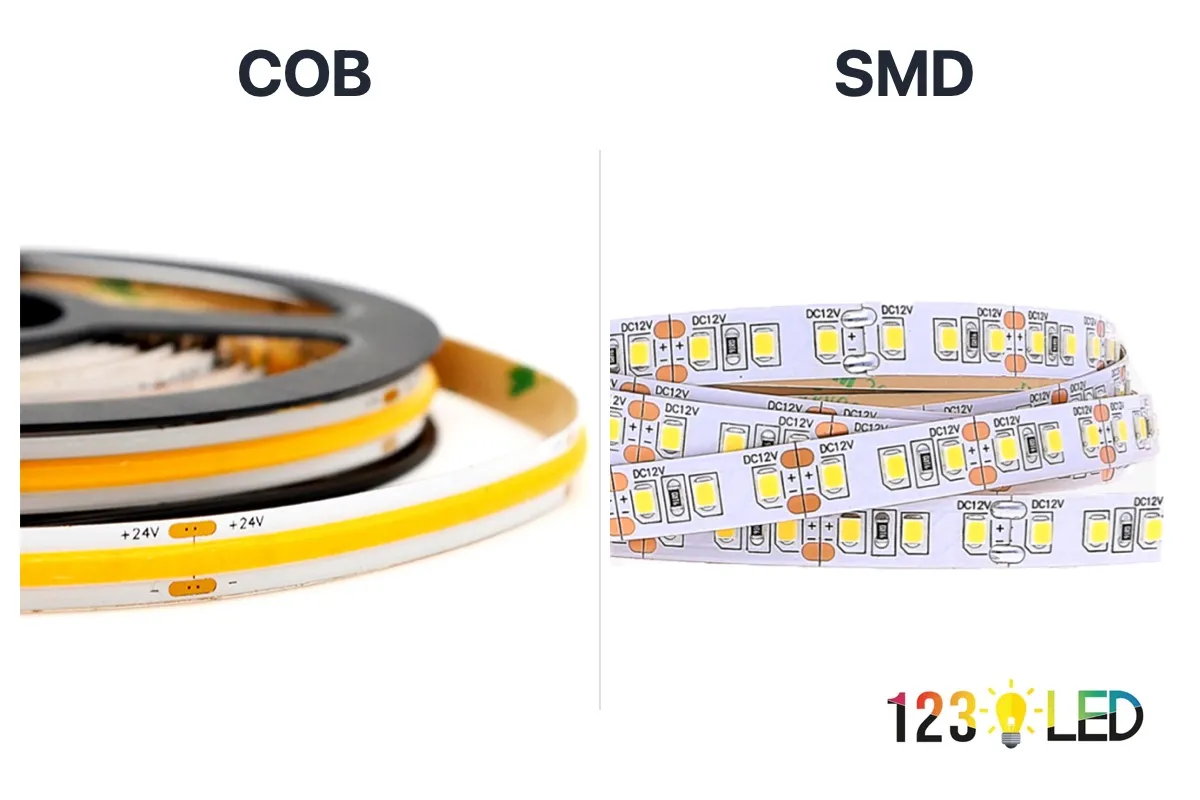
COB (chip-on-board) LEDs pack many tiny chips under one continuous layer of phosphor, so they give a smooth, dot-free line or a single bright spot. SMD (surface-mounted device) LEDs are separate small packages, such as 2835 or 5050, spaced along a board. Choose COB where the light is visible; choose SMD for hidden cove lighting, RGB effects or the lowest cost per metre.
Key takeaways:
- COB and SMD are two ways of packaging LED chips, not two different kinds of light. Both are efficient LED lighting.
- COB strips look like one continuous line, with no dots, even without a diffuser. SMD strips show individual dots unless they sit in a deep, diffused profile.
- SMD strips cost less per metre and offer more choice (2835, 5050, RGB). On our price list a COB strip costs about S$5 per metre and an SMD strip S$3 to S$3.50 per metre.
- In downlights and spotlights, a COB module behind a reflector gives a tighter, more defined beam; SMD-based fittings usually spread light more widely. Check the beam angle on the product page.
What is the difference between COB and SMD LED?
The difference is how the LED chips are packaged. An SMD LED is a complete, individually packaged LED that is soldered onto a circuit board. A COB LED mounts many bare chips directly onto one board and covers them with a single phosphor coating, so the whole group lights up as one surface.
That one design choice changes three things you notice at home: how the light looks (dots or a smooth line), how the light spreads (wide or focused) and how much heat builds up in one spot. It does not automatically make one type brighter or more efficient. Efficiency depends on the specific chips, driver and fitting, not on COB or SMD. Our white COB and SMD strips both draw about 11W per metre, so they cost about the same to run.
What is an SMD LED?
SMD stands for surface-mounted device. Each LED is a small rectangular package with its own lens and contacts, and the package size is in its name. A 2835 LED measures 2.8 × 3.5mm, a footprint that Lumileds uses for its LUXEON 2835 range, and a 5050 LED measures 5.0 × 5.0mm.
- SMD 2835: the common choice for white LED strips and many bulbs, tubes and panel lights. Our SMD 2835 LED strip has 120 LEDs per metre.
- SMD 5050: a larger package, commonly built with three chips (red, green and blue), which is why it is the classic RGB (colour-changing) strip. Our white SMD 5050 LED strip has 60 LEDs per metre.
Because the LEDs sit apart, you can see each bright point when you look at an SMD strip directly. Hidden inside a cove or behind a deep diffuser, the dots blend into an even glow.
What is a COB LED?
COB stands for chip-on-board. Instead of separate packages, many small LED chips are bonded straight onto one board and covered by a single phosphor layer. The result is one light-emitting surface. Major chip makers such as Lumileds sell COB arrays by the size of that light-emitting surface, for spotlights, downlights, retrofit lamps and outdoor and industrial fittings.
COB is used in two quite different products:
- COB LED strips: chips packed so closely along a flexible strip that the strip lights up as one smooth line. Our COB LED strip packs several hundred chips per metre, compared with 60 or 120 on our SMD strips.
- COB downlights and spotlights: one compact, very bright COB module behind a reflector, giving a focused beam. Our recessed COB spotlight is an example.
COB vs SMD LED: side-by-side comparison
This table compares the two types as they are used in home lighting. Strip specifications and prices are from our own catalogue in November 2026; check the product page for the current price.
| Feature | COB LED | SMD LED (2835 / 5050) |
|---|---|---|
| How it is built | Many bare chips on one board under one phosphor layer | Separate packaged LEDs soldered along a board |
| Look when lit | Continuous line or single bright spot, no dots | Row of bright dots unless diffused |
| Needs a diffuser? | Not for a smooth look | Yes, if the strip is visible |
| Light spread | Even along a strip; focused beam in spotlights | Wide spread; good for general and indirect light |
| Colour options | White, warm, tunable white, some RGB | Widest choice, including RGB 5050 |
| Cutting (our strips) | Every 5cm | Every 2.5cm (2835) or 5cm (5050) |
| Power (our strips) | About 11W per metre | About 11W per metre |
| Tunable white (our 10m strips) | S$90 (about S$9 per metre) | S$60 for SMD 2835 (about S$6 per metre) |
| Price per metre (our white strips) | About S$5 (S$25 for 5m) | About S$3 to S$3.50 (S$15 for 5m 5050; S$35 for 10m 2835) |
| Heat | Concentrated in a small area; needs good heat-sinking | Spread out over more board area |
Is COB LED better than normal LED?
COB is not "better" than a normal LED in every way; it is better at looking smooth. When people say "normal LED" they usually mean an SMD strip or bulb. COB wins where you can see the light source itself, such as an exposed strip under a shelf or a spotlight beam on a wall. SMD wins on price, colour choice and flexibility.
Both last a long time when they run cool. LED lifetime is usually rated as the hours until output drops to 70% of the original (called L70), as the US Department of Energy explains. Heat shortens that life for any LED, so mount strips on an aluminium profile and don't box downlights in: leave some space above them in the false ceiling.
Which is better for LED strip lights: COB or SMD?
For strip lights you can see, COB is usually the better choice. For strip lights you cannot see, SMD does the job for less. A simple way to decide in a Singapore HDB flat or condo:
- Under-cabinet kitchen lights, open shelves, display cases and wardrobe lights: COB. The strip is visible from many angles, and a dotted reflection on a glossy kitchen top looks cheap.
- Ceiling cove lighting (false ceiling or L-box): SMD 2835 is fine, because the strip faces up and you only see the glow. COB still gives a cleaner line on the ceiling if the cove is shallow.
- TV console backlight and bed headboard: either works. Choose COB if the strip will show, SMD if it is fully hidden.
- Colour-changing or party lighting: SMD 5050 RGB has the most controller and colour options; we also stock a COB running RGB strip if you want the smooth look.
- Tunable white (warm to cool): both exist. Our COB tri-colour strip is S$90 per 10m and our SMD 2835 tri-colour strip is S$60 per 10m.
Whichever strip you choose, it needs the right 12V or 24V power supply. Our guide to choosing an LED driver covers sizing, and our LED strip installation guide covers profiles, cutting and connectors. You can compare all our strips on the LED strip light collection.
Are COB downlights and spotlights better?
COB downlights and spotlights are better for accent and feature lighting, where you want a defined beam on a wall, artwork or display. SMD-based downlights and panel lights are better for general room lighting, where you want light spread evenly across the floor without strong shadows.
Because a COB spotlight puts out its light from one small, bright surface, a good fitting uses a deep reflector or recessed lens to reduce glare. Look for a spotlight where the COB module sits well back inside the housing. For a living room, a common layout is general SMD downlights or a ceiling light, with a few COB spotlights to highlight a feature wall or a shelf. Our guide to the types of LED lights explains which fitting suits each room.
What about DIP LEDs?
DIP (dual in-line package) LEDs are the older "bullet" LEDs with two long legs that go through a circuit board. They are still used for indicator lights, some outdoor signs and decorative lights, but most home lighting today uses SMD or COB. If an old fitting uses DIP LEDs, replacing the whole fitting with a modern SMD or COB one is usually the better option.
How do you choose between COB and SMD?
Ask three questions before you buy:
- Will you see the strip or the light source? If yes, choose COB. If it is hidden, SMD is fine.
- Do you need colours or the lowest cost? RGB effects and long, hidden runs favour SMD.
- Is it a beam or a wash? Spotlights for a focused beam favour COB; general room lighting favours SMD downlights or panels.
If you are not sure, send us a photo of the space and the length you need through our contact page, or visit our shop at Sim Lim Tower to see the strips in person.
Frequently asked questions
Is COB LED brighter than SMD?
Not automatically. Brightness (lumens) depends on the chips, how many there are and the power, not on COB or SMD alone. Our white COB and SMD strips both draw about 11W per metre, so expect similar light output; COB looks more intense because the light comes from one continuous surface.
Does COB LED strip need a diffuser?
No, a COB strip already gives a smooth, dot-free line. An aluminium profile is still a good idea, because it helps the strip stay cool and keeps the adhesive in place.
Can I cut COB LED strips?
Yes, at the marked cut points. Our COB strips can be cut every 5cm. SMD 2835 strips can be cut every 2.5cm.
Which is better for cove lighting, COB or SMD?
For a standard ceiling cove where the strip is hidden and faces up, SMD 2835 gives an even glow at a lower cost. Choose COB if the cove is shallow or the strip may be visible from the room.
Need help choosing LED lighting for your home or office? Ask our team.
Contact 123 LED Lighting