
How to Change a Fluorescent Tube to LED in Singapore
By 123 LED Lighting · Published · 11 min read
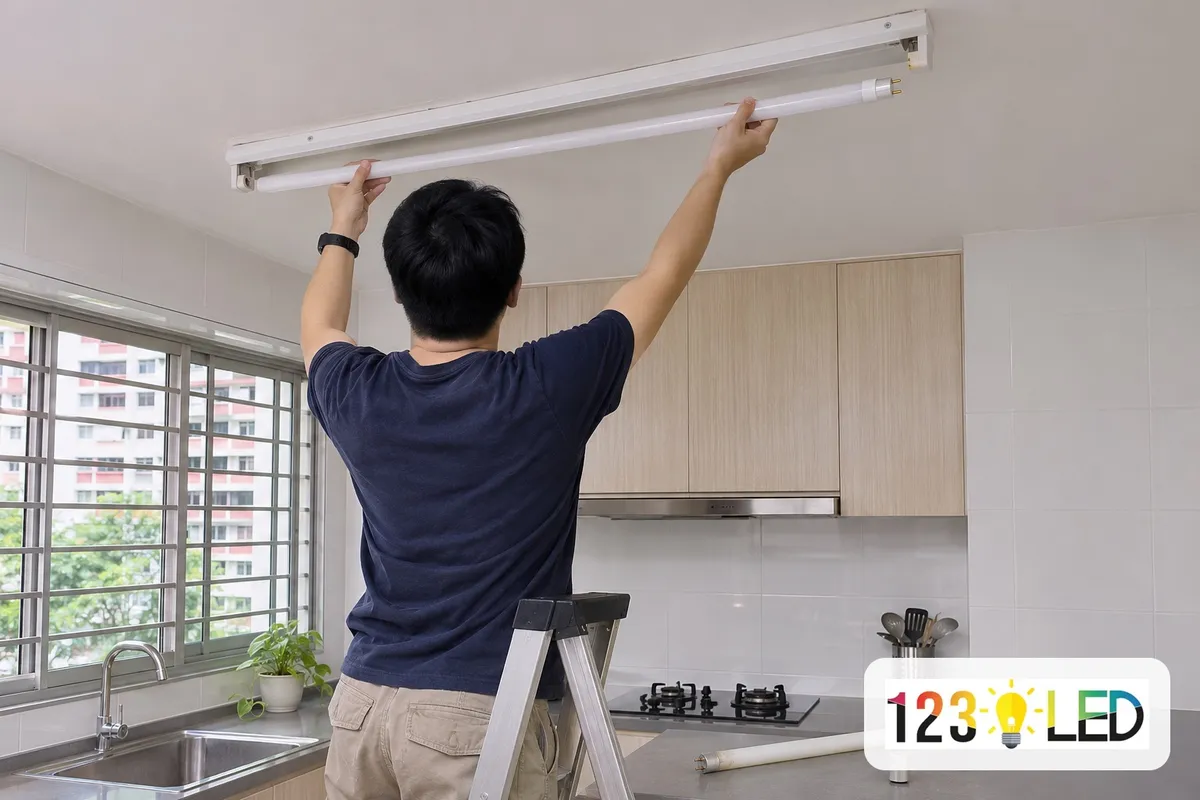
To change a fluorescent tube to LED, first check whether the fitting has a starter. If it does, you can usually fit an LED tube with an LED starter. If it has an electronic ballast, use a tube listed as compatible or have the ballast bypassed. If the fitting is old, replacing the whole thing with an integrated LED tube is often simplest.
Key takeaways:
- A small cylindrical starter in the fitting points to a magnetic ballast. No starter usually means an electronic one.
- The tube decides the wiring. Our T8 LED tube is double-end powered, so the ballast and starter must be removed and live and neutral fed to opposite ends.
- At the current household tariff, replacing a 36W tube with a 24W LED saves about S$4 a year in a kitchen used three hours a day, or S$32.76 a year in a light that never switches off.
- Switch off at the distribution board, not just the wall switch. Leave any rewiring to a Licensed Electrical Worker (LEW).
Which LED route fits your fitting?
Three questions settle it: does the fitting have a starter, what type of LED tube are you buying, and is the fitting worth keeping? The answers point to one of three routes: keep the ballast, bypass it, or replace the fitting. The table covers four common situations.
| Your situation | Best route | Rewiring? | Who should do it |
|---|---|---|---|
| Starter present, fitting sound | LED tube made for magnetic ballasts, plus its LED starter | No | A careful homeowner with the power off |
| No starter (electronic ballast) | LED tube on the maker's compatible-ballast list, or a ballast bypass | No, or yes if bypassed | LEW if bypassed |
| You want a direct 230V tube, such as our T8 | Remove ballast and starter, wire mains to the tube holders | Yes | LEW |
| Cracked holders, rust, buzzing, yellowed cover or a hot enclosed fitting | Replace the fitting with an integrated LED tube (indoors) or an IP-rated fitting (wet areas) | Connect to the existing point | LEW recommended, especially if hardwired |
How do you tell which ballast you have?
Look for a starter, a small removable cylinder on the fitting. LEDVANCE's installation guide says a fitting with a starter needs a tube made for conventional ballasts, and one without needs a tube made for electronic ballasts. Three quick checks help:
- Starter check: a starter points to a magnetic ballast; no starter usually means electronic.
- Phone camera check: if the old tube still works, view it through your phone camera. LEDVANCE says visible flicker points to a conventional ballast. No visible flicker suggests an electronic one, but some phone cameras hide flicker, so don't rely on this alone.
- Label check: with the power off, read the ballast label, and look for a warning sticker showing that the fitting has already been converted.
Also note the tube size and pins. A T8 is about 26mm across with wider-spaced G13 pins; a T5 is thinner with closer-spaced G5 pins. They are not interchangeable. Write down the length and wattage before you shop. Our T5 product replaces the whole fitting; it does not plug into an existing T5 holder. You can compare sizes on our LED tube light collection.
How do you change a tube when the fitting has a starter?
Use an LED tube made for magnetic ballasts, and fit the LED starter that comes with it. Philips' quick installation guide gives this basic order; we have added isolating at the distribution board and letting the tube cool:
- Turn off the power at the distribution board and let the tube cool.
- Remove the old tube.
- Take out the old starter.
- Fit the LED starter.
- Fit the LED tube with its light opening facing down.
- Turn the power back on.
Do not leave the ordinary starter in. With LEDVANCE's tubes, the light then blinks and the tube can be damaged. Their guide also says the ballast that stays in the fitting usually loses only about 1W. An LED starter works only with its LED tube, so don't reuse it with a fluorescent tube.
Our T8 LED tube is not this type. Do not fit it in a starter fitting unless the ballast has been bypassed first.
What if there is no starter?
No starter usually means an electronic ballast, and a tube not listed for that ballast may not work on it. You have two choices. Buy a tube the maker lists as compatible with your exact ballast model, or bypass the ballast and feed 230V directly. The first is quicker. The second removes a part that could fail later.
For a bypass, LEDVANCE says the built-in gear must be removed and the conversion done by a qualified electrician. Some direct-wire tubes take live and neutral at one end only. For its own, Philips' mounting instructions say to match the L/N markings and place the supplied warning sticker where it is visible during lamp replacement. Label every bypassed fitting, and never put a fluorescent tube back into it.
How is our T8 LED tube wired?
Our T8 LED tube is double-end powered at 230V, which means live goes to one end and neutral to the other. The old ballast and starter must come out first. It costs S$5 for 2ft (8W) and S$6 for 4ft (24W or 30W), with a one-year warranty. Prices were correct in November 2026.
This is why a tube sold for one wiring type can be the wrong buy for your fitting. Before ordering, check three things on the box: single-end or double-end power, "ballast compatible" or "direct 230V", and the length. Never fit a double-end tube in a fitting that feeds live and neutral to the same end: on some tubes the two pins at each end are joined inside, so it can short the supply. Have the holders rewired first and follow the diagram supplied with the tube.
A fluorescent ballast is not an LED driver. With a direct 230V tube, the driver is inside the tube, so there is nothing separate to fit. Other LED products need one, as our guide to what an LED driver does explains.
When should you replace the whole fitting?
Replace the fitting when the holders are cracked, the cover has yellowed, the ballast buzzes or you would pay an electrician anyway. An integrated tube has the driver and body in one piece, so there is no old ballast to diagnose. Our LED T5 integrated tube runs from S$4.90 (1ft, 5W) to S$8.50 (4ft, 20W) with a two-year warranty.
Other cases for a new fitting:
- Outdoor or wet areas: use a sealed casing. Our weatherproof casing is IP65, and the 4ft single is S$35 with the tube sold separately. Check that the tube is rated for enclosed fittings and the temperature inside.
- Offices: if the old battens look tired, an office linear light replaces the whole fitting in a white or black frame.
- Small, hot or sealed indoor fittings: LEDVANCE warns that LED tubes are more sensitive to heat than fluorescent tubes, especially in narrow, closed or multi-lamp fittings. An open fitting is usually the safer choice indoors.
How much does the swap save in Singapore?
Saving per year = (old watts − new watts) × hours ÷ 1,000 × tariff. The table uses SP Group's household tariff of 31.16 cents/kWh including GST (1 October to 31 December 2026) and an old 36W tube. It ignores ballast losses, so removing an old ballast will usually save more than shown. It compares energy only, not equal brightness.
| LED replacing a 36W tube | Kitchen, 3h a day (1,095h a year) | Office, 10h, 6 days a week (3,120h) | Car park, 24h (8,760h) |
|---|---|---|---|
| 4ft T8, 24W | S$4.09 a year | S$11.67 a year | S$32.76 a year |
| 4ft T8, 30W | S$2.05 a year | S$5.83 a year | S$16.38 a year |
| 4ft T5 integrated, 20W | S$5.46 a year | S$15.56 a year | S$43.67 a year |
Two lessons follow. Running hours matter more than the tube: a kitchen light pays back slowly, while a light left on all day pays back fast. And wattage matters: our 30W tube saves only half as much as the 24W tube, so buy it for the light, after comparing lumens, and not for the bill. All three columns use the household rate; businesses on other plans should use their own.
Three worked examples
- HDB kitchen, one 4ft tube, 3h a day: a S$8.50 integrated tube saves about S$5.46 a year, so the hardware pays back in about 19 months. Do it because the ballast is failing or the fitting is worn, not for the bill, and compare lumens first: a 20W fitting may give less total light than a 36W tube.
- Office with 20 twin fittings (40 tubes): forty 24W tubes cost S$240 and save about S$467 a year, so the tubes alone pay back in about six months. Add the LEW's quote before you decide, and ask about twin fittings where two tubes share one ballast.
- Car park light on 24 hours: a S$35 casing plus a S$6 tube is S$41 and saves about S$32.76 a year, a payback of about 15 months on parts.
Planning to pay with Climate Vouchers? The eligible list names LED lights with two ticks and above, including circular lights and downlights. Tubes are not named, so check first. Our Climate Voucher page shows how to redeem them with us.
Will it be as bright?
Compare lumens, not watts. NEA's minimum standard is 75 lumens per watt for T8 and T5 fluorescent tubes and 100 for LED tubes between 0.5m and 1.5m. At those minimums, a 36W fluorescent gives about 2,700 lumens and a 24W LED about 2,400. Many fluorescent tubes beat the minimum, so compare the figures printed on both. The LED may give less in total, but it points its light down, where a bare fluorescent sends light in every direction.
Check the lumens printed on the box and the colour: 3000K is warm white, 4000K is cool white (also sold as neutral) and 6000K is white, close to daylight. Our 4ft 24W comes in 4000K or 3000K; the 30W comes in 6000K only. For task areas such as a kitchen counter, choose the higher lumen option.
Do you need an electrician in Singapore?
For a tube and starter swap with no rewiring, usually not. For a bypass, yes: EMA says repair or modification of electrical wiring, and replacement of lighting points, should be done or supervised by a Licensed Electrical Worker. Replacing a whole fitting sits in between. EMA's Inspectorate Department says a good rule of thumb is that an LEW is needed when work draws a new connection, and not when you simply connect a lighting fixture to an existing point. We still recommend an LEW if the fitting is hardwired. In an HDB flat, that means a licensed electrician; ask to see the licence card.
Never work on a live fitting. Turn off the circuit at the distribution board, test that it is dead, and use a stable ladder. A double-end powered tube connects to mains at both ends, so never fit one with the power on.
Where do old tubes go?
Don't put long tubes in an ordinary e-waste bin. ALBA E-Waste collects long fluorescent tubes only at its e-drives, its depot at 20 Tuas Loop and selected e-bins. NEA says long fluorescent and LED tubes are not accepted in the bins and points to ALBA's collection drives or doorstep collection. Fluorescent tubes contain mercury, so keep them whole.
If a tube breaks, Signify's advice for its own lamps is to ventilate the room for 30 minutes, wear gloves, put the pieces in a sealed bag and not use a vacuum cleaner. ALBA asks for broken lamps to go in general waste, not the e-bin.
Will fluorescent tubes disappear?
Yes, gradually. Parties to the Minamata Convention agreed to phase out general-lighting linear fluorescent tubes, with a 2026 phase-out date for halophosphate types and 2027 for triband types. Spare tubes should get harder to find. If you have a large site, plan the change on your own schedule, not when stocks run out.
Not sure what you have?
Take a clear photo of the fitting, the starter and the old tube's markings, and note the length. Send them through our contact page. We can tell you which tube fits, or whether a new fitting makes more sense.
Frequently asked questions
Can I replace a fluorescent tube with LED without rewiring?
Yes, if the LED tube is made for your ballast. A fitting with a starter usually takes an LED tube plus an LED starter. A fitting with an electronic ballast needs a tube on the maker's compatible list. A direct 230V tube always needs the ballast bypassed.
Do I need to remove the ballast when changing to LED?
Only for tubes that run on direct 230V. Our T8 LED tube is double-end powered, so the ballast and starter must be removed and the holders rewired by a Licensed Electrical Worker. LED tubes made for magnetic or electronic ballasts can leave the ballast in place.
How much does it cost to change a fluorescent tube to LED in Singapore?
Our T8 LED tubes are S$5 for 2ft and S$6 for 4ft, and an integrated 4ft T5 tube is S$8.50 (November 2026). Labour for a Licensed Electrical Worker is extra and depends on the number of fittings and how easy they are to reach.
What is the difference between a T5 and a T8 tube?
T5 is the thinner tube with closer-spaced G5 pins. T8 is the thicker tube, about 26mm across, with wider G13 pins. They do not fit the same holders.
Need help choosing LED lighting for your home or office? Ask our team.
Contact 123 LED Lighting